Category: random

  • Snow Globe

    Snow piled up, the power went out, and the roads were closed. And still wet, heavy flakes continued to fall, settling on everything, making life miserable for the residents of Virginia City.

    It was nothing new.

    Storms like this one they were experiencing were commonplace, albeit disastrous for the unprepared or worse for the ones who ignored all the signs. And that was the problem, learning to read the sign, to tell when a storm of this magnitude would settle on the mountain village that attracted thousands annually.

    In darkness or gray sky, God shook the damned snow globe again.

  • The Best Gift

    My wife calls me a hoarder, though I prefer the label ‘pack rat’ better. But names aside, I collect objects and store them in collection bins with other a-like things.

    When I find something I have nothing to pair with, it ends up in a large wooden box that once belonged to my wife’s grandparents. And sometimes, it gets too full and cannot be closed.

    When this happens, we set about removing, rearranging, and throwing some items away. My wife rarely asks why I save this or that.

    In November, we poured through the box, pulling everything out and setting it aside before reloading it neatly. She surprised me by asking about a set of binoculars I’ve had since 2nd grade.

    “Why are you keeping these?” she said. “They don’t work.”

    “They’re sentimental to me,” I said. “Let me explain.”

    It was Mrs. Newquist’s class that Brett first came. He was a bright kid, but anyone could tell by his clothes and the free government lunches that his folks were not well-off. We used to hang out on the playground and at home since we were neighbors.

    Come Christmas time, having saved my chore money, I bought him a model car kit. Brett was fascinated by anything on four wheels.

    We exchanged gifts. I saw the delight in Brett’s eyes at the neatly wrapped package Mom had helped me do.

    Then he handed me my gift wrapped in writing paper, the lined type we used for practicing penmanship. I tore it open, only to find his stupid, broken binoculars that he always had around his neck.

    Hurt, I raced home crying and hid in my bedroom. It was there that Mom found me and explained how it was the best gift he could have given me, it was all that he had to offer, and he’d given them to me from the heart.

    “Once I understood this, I was happy with them, and we played with them all the time, busted or not,” I said. “And that’s why I still have them, to remind me about what real giving is about.”

    She handed them back to me, and I slipped them into the box.

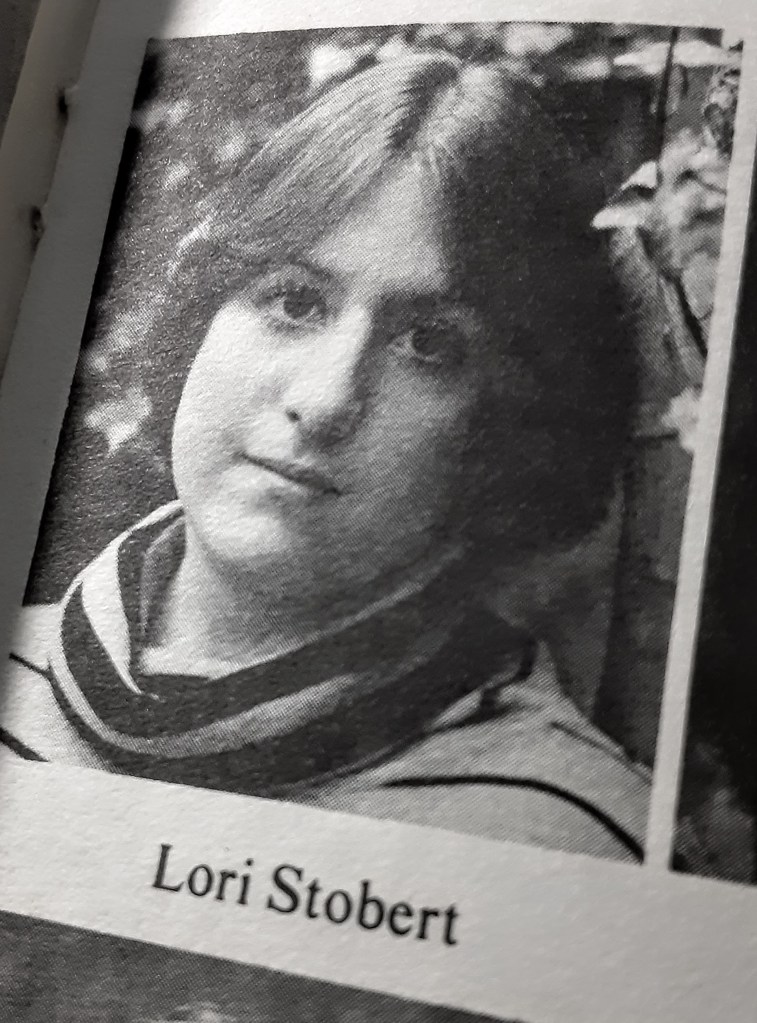
  • Lorri Stobert, 1960-2022

    It has taken me some time to clear my head and heart to the point I feel brave enough to admit I am selfish. On my desk is a seven-page letter I meant to send to Lorri but forgot about several times, and now she is passed, and I have no one to which to mail it.

    Lorri and I had known each other since kindergarten at Margaret Keating Grade School. Not only that, we graduated from Del Norte High School together.

    Her father and mine served in the Air Force during the Korean and Vietnam wars. While my dad stayed in the service until 1972, Mr. Stobert received his discharge in 1965, if my memory serves me, and settled down in Klamath, below the radar base where he had worked. He was the head chef at the Requa Inn, where my brother worked for him, save for the month I took over for my brother after he broke his arm and could not wash dishes.

    Lorri was always a shy child and grew into a shy woman, at least the last time we saw one another face-to-face. Though I learned that she hated to tease me, her fear of ridicule outweighed her hate, so when goaded into it, Lorri went along to get along.

    In the letter on my desk, I wrote about how I remembered an early evening at the Trees of Mystery when I was sitting on the wood railing outside the shop talking to a tourist girl, and I caught Lorri looking at us. I recalled how our eyes locked and how we smiled at one another like we each held a piece of a secret.

    A couple of years after high school graduation, we bumped into one another in front of the Del Norte Triplicate office at the corner of H St. and Third in Crescent City. We stood there for over two hours talking, and we promised each other that we’d get a cola or a coffee one morning before I headed off to the Marine Corps.

    Sadly, that never happened.

    We lost touch for years afterward, and I only learned she was in SoCal the evening I was attacked by someone who tried to choke me out with a rope, and I drove to the Trees Motel and asked to use the phone to call the sheriff’s office, which Mrs. Stobert obliged me.

    When FB came on the scene, I was quick to ‘friend’ Lorri, and where we chatted over the years. She always asked me to visit, and I always said I would, though I never managed to get around to it.

    And now, I can’t, even though I declared in the letter that we would celebrate her birthday this June. The thought leaves me heartbroken.

    So what to do about this unsendable letter?

    It finally came to me. I will burn the letter allowing the smoke to carry my words and thoughts into the heavens, and perhaps Lorri will receive them.

  • Routes and Settlements in Nevada from 1844 to 1857

    After Mexico ceded lands to the U.S. in 1848 and the Spanish Trail abandoned, Mormons in Salt Lake City began utilizing the western portion of the route to southern California beginning in December 1847, when Porter Rockwell led a party and their wagons from Salt Lake to Southern California for supplies.

    Most of the traffic during the 1848-1857 period was of the Mormon faith, giving the popular route its later name, the Mormon Road. The Mormon Road was one component of church plans for expansion in the Great Basin and southern California.

    Brigham Young developed plans for the “State of Deseret” in 1849, a vision of massive Mormon holdings in the Great Basin, the Colorado River drainage, and southern California. However, California was awarded statehood in 1850. In the same year, lands in the east split along the 37th Parallel, with one section becoming New Mexico Territory and the other Utah Territory.

    The planned “Deseret” was never even considered by the federal government. Nevertheless, Young was appointed territorial governor by President Fillmore.

    The early and mid-1850s saw the expansion of Mormon settlements to southern California, where in 1851, they built the San Bernardino Mission, to the Lower Colorado River region, the eastern front of the Sierra in Carson Valley in 1851, and the Las Vegas area with the Las Vegas Mission established in 1855.

    Regardless of the intention of the Mormon Church to strategically settle unoccupied lands west of Salt Lake City, the earliest founding of settlements in Nevada was because of a need to supply emigrants passing through the area on their way to California. It happened to be mostly Mormons who settled first in attempts to capitalize on the traffic moving across these vast desert regions.

    Genoa, one of the first settlements in Nevada with a permanent structure, was established in 1851 by John Reese, a Mormon businessman from Salt Lake City. The original trading station consisted of a log cabin and stockade and fell within the newly-created Utah Territory at its western boundary.

    In 1850, Joseph DeMont and Hampton S. Beatie built a temporary cabin at the site, near the Carson River and at the base of the Sierra Nevada, believing it would be a lucrative one to sell supplies to emigrants rushing to California. By the end of the summer that year, the trading outfit quickly became known as “Mormon Station,” and reportedly had two trading posts and five log cabins, making the small settlement swiftly known as “the principal trading-post east of the Sierra.”

    Just before winter that year, Beatie and DeMont returned to Salt Lake City after selling the cabin to Mr. Moore, who sold it in the summer of 1851 to John Reese. Reese built a second, more permanent cabin near the Beatie cabin. The successful trading business attracted other settlers to the area by the end of his first summer of business.

    “Mormon Station,” as reported in the Sacramento Union in a letter dated July 20, 1851, consisted of “3-4 buildings, tent, a spring house, and 2-3 corrals.” The trading station also served as one of Woodward and Chorpening’s Overland Mail stations.

    In November 1851, over 100 settlers met at the Mormon Station, meetings three times formulated a local government through a sort of “squatter consensus.: Salt Lake City was too remote from Carson Valley to effectively govern the settlers, who were Mormon and non-Mormon alike.

    In 1853, Carson Valley residents petitioned the California legislature to annex the land to California as a stop-gap until the U.S. Congress could act on the legislation. The annexation effort forced the Utah government to take notice of its most distant settlement, creating Carson County from the westernmost parts of four other counties in the territory.

    However, this was a measure taken by the Utah government noted in documents only. Eventually, the Salt Lake City-based leaders had to give up what little control they previously had over their westernmost and most distant colony.

    In May 1851, eight men brought the U.S. Mail east from Sacramento to Salt Lake City for the first time. In the summer of 1852, traveler John Farrar noted thousands of wagons at Humboldt Sink.

    At Ragtown, he observed a corral made entirely of wagon tires. Gardens in Carson Valley, with vegetables such as onions, potatoes, watermelons, pumpkins, musk melons, and beets, were described by travelers in the summer of 1852, as well as hay fields and a blacksmith shop at Mormon Station was established by July 1852.

    Another traveler wrote of passing gardens and houses on his way to Mormon Station along the road from Gold Canyon, which were about a mile apart, irrigated with ditches. He also noted a bakery and “good farms” at Mormon Station. The settlement began taking characteristics of a Mormon farming community, “with distinctive large lots providing for widely spaced houses to be surrounded by gardens, lawns, groves or orchards.”

    In September 1852, Henry Van Sickle arrived in Carson Valley to set up a smithy at the base of Georgetown Trail. He later became a major landholder in the valley, Justice of the Peace, County Commissioner, County Treasurer, and State Assemblyman, eventually holding other positions. By this time, a post office was operating at Mormon Station.

    Israel Mott settled four miles south of Mormon Station in the fall of 1852, building his home out of abandoned wagon beds salvaged at the base of Carson Canyon and Mormon Station. On December 1, 1852, Carson Valley residents recorded the first formal land claims, including Israel Mott and John Reese, who legitimized their claim on collecting tolls in Carson Canyon on this date.

    After this, fencing and landowners controlled the movement of emigrants through the valley. Meanwhile, John Cary sawed the first plank at his new sawmill at the northern boundary of Carson Valley in July 1853. It was the first sawmill in the western Utah Territory.

    In general, settlers enjoyed amicable relations with Native Americans based in Nevada except for minor conflicts among the large volumes of travelers on the emigrant trails in northern Nevada. In Life among the Piutes, Sarah Winnemucca gives a detailed account of a situation in 1857 in Carson Valley involving Washoes accused of murder, Northern Paiute negotiators, and Major Ormsby serving justice.

    In 1854, Young developed a government for the western Utah Territory. A prominent Mormon church official, Orson Hyde, was appointed the probate judge to organize Carson County as part of the Utah territorial government. Hyde arrived in Carson Valley in 1855 with 38 Mormon settlers and changed the name to Genoa.

    The arrival of a large group of Mormons to Carson Valley alarmed non-Mormon settlers, and they took up the annexation again in 1855 with the California legislature, who warmly received the proposed addition of lands to their state.

    However, many in the U.S. Congress, believing California was already too large, opposed it and refused to take action. Meanwhile, Hyde had placed Mormons in all but one elected position to facilitate Mormon control, surveyed the town of Genoa, established the Franktown community in Washoe Valley, and built a much-needed sawmill.

    Hyde left Carson Valley in November 1856, and in the summer of 1857, 64 Mormons left Carson Valley to return to Salt Lake City, followed by another 450 Mormons called back by Young. Mormon control of Carson Valley was again ineffectual, although it still officially fell under the governance of the Utah Territory.

    By the fall of 1857, Genoa had roughly 25 buildings, including a store, billiard saloon, hotel, and blacksmith shop. Two hundred residents remained after the recall, some of them Mormons. Again, the “squatter movement” rose to the occasion in Carson Valley, petitioning this time for separate territorial status. They were unsuccessful at gaining that status until 1861, following the discovery of gold and silver in Virginia City, although they formed their local government in the interim.
  • Broken Promise

    Despite promising myself not to write any more weird stories of the supernatural or paranormal in late November, I find myself putting this one to paper with the hope of ridding my brain of the ever-playing memory I witnessed on my way home.

    It had grown dark when I started north on Geiger Grade last night. The rain, a slight drizzling nuisance much of the day, had become a near-blinding downpour.

    Having driven down to where I could see the Virginia Foothills and the metros of Reno and Sparks further in the valley, I had been going slower than the posted speed. At the second to last curve before reaching the final turnout and just beyond my headlights, I thought I saw the beginning of a rock slide.

    Slowing to a near stop, I watched as the large boulder tumbled, then spread out onto the roadway, before standing up. It was not a mineral deposit but an animal that my brain translated into a big dog or smallish bear.

    In one stride, it leaped over the guardrail and disappeared down the steep grade, or so I thought. As I pulled alongside where the thing had gone, I saw a man walking outside the rail.

    As I passed him, he turned his head and looked at me. Much of his bearded face was shrouded in darkness, yet the car’s headlights caught his eyes, which glowed a phosphoretic green.

    Stepping on the gas pedal, I drove rapidly down the hill toward the end of 341. But not even speeding would prevent me from seeing him again as he was now standing slightly outside the glow of the light cast by the 7-11 store.

    And though I had an anniversary party to return to Virginia City to attend, I withdrew to the safety of my home, desirous of not venturing into the dark and rain of the night again.

  • Welcome to My 2023

    During December, I refused to blog, and it was good. It gave me time to think, to evaluate my two decades of work.

    At one point, I was going to delete my site and make it disappear. But I changed my mind after waffling back and forth on the idea.

    Finally, I waffled in the direction of keeping my blog, deleting all 1,255 followers and whatever number of email subscribers I had since I started. It was so I could start over in some respect.

    So, here I am. And I don’t give a-good goddamned about anyone reading what I write anymore. I came to this conclusion after no one recognized that I was not posting anything.

    Having 31 days off gave me a new perspective and a want to change directions. Tired of niceties, I plan to be more down and dirty, sharing real stories, and being more direct about how I feel and think.

    So let’s do this fucking thing.

  • That Time Santa Got Lost

    “Rudolph has COVID?” Santa asked with surprise.

    “‘Fraid so,” answered the Large Animal Vet. “And he’s gonna need lots of rest and fluids, so he’s won’t be able to guide you this Christmas eve.”

    Stunned, Santa walked from the barn to the house.

    “Don’t know what I’m going to do with out him,” he complained to Mrs. Claus.

    “You used to do the job when he wasn’t part of your sleigh team.”

    “Yeah, I used to do this job without him, it jus’ seems so long ago.”

    “I’m certain you can do it.”

    “Thank you, dear.”

    They were nearly nine hours into their trip when Santa realized he had led the team in the wrong direction, off course, over California instead of West Texas. It took him a few minutes to finally find an isolated place to set down.

    “Well, now what?” he asked as he checked his GSP against the paper map he always carried.

    “Okay, here we are,” he stated, a stubby finger pointing to the Alabama Hills between Independence and Lone Pine, off of US 395.

    Then he heard sounds coming from an outcropping of rocks off to his right.

    “Maybe they can help me by giving me directions or something?”

    As he rounded the outcropping, he stumbled onto the set of a Star Trek episode. Kirk, Spock, Sulu, Scotty, Uhura, and Bones McCoy were battling seven eight-armed creatures, a blaster wrapped in each tentacle, and for some reason, the Enterprise could not lock onto their signals.

    It is too bad Santa was the one wearing red.

  • Nevada Backroads: Mizpah Mine

    Dominating Tonopah’s golden era is the Mizpah Mine. Renowned as the most prosperous among Tonopah’s many mines, its metal headframe was an early marvel of steel hoisting technology, setting a precedent for the industry nationwide. The mine’s historical significance was reaffirmed in 2015 with the completion of the collar restoration, inviting visitors to witness its grandeur firsthand.

    Tourists are welcomed to stand atop a grate, peering down into the depths of the 600-foot shaft, illuminated for exploration. Inside the hoist house, a treasure trove of vintage machinery awaits, including intact hoisting works and venerable air compressors preserved in their original positions.

    Today, the Mizpah Mine is a part of the Tonopah Historic Mining Park & Foundation.

  • Nevada Backroads: Rhyolite

    Rhyolite is a testament to the fleeting nature of prosperity born from an accidental gold strike in 1904 and swiftly rising from the desert sands, Rhyolite transformed into a bustling town, its heart pulsating along Golden Street with mineral wealth in the nearby Bullfrog Mountains.

    Rhyolite boasted a population exceeding 10,000 residents, a remarkable feat considering its remote location. The town flourished with modern amenities uncommon in frontier territories, such as electricity, telephones, and automobiles.

    However, as quickly as Rhyolite rose to prominence, its fate turned. By 1910, the once-abundant veins of gold began to dwindle, signaling the beginning of the end, and with the decline, residents began to depart, seeking greener pastures elsewhere.

    Today, Rhyolite stands silent, streets now deserted.

  • Nevada Backroads: Aurora

    In the annals of Nevada history, the tale of Aurora unfolds as a poignant narrative of boom and bust, hope and despair, in the Eastern Sierra Nevada Mountains. Unlike its sister town across the border in Bodie, California, which retains some semblance of its former glory, Aurora met a tragic fate in the 1940s.

    Aurora’s origins trace back to the silver rush of the 1860s, a time when fortunes were made and lost in the pursuit of precious metals. Initially known as Esmeralda, the town experienced a rapid influx of settlers following the discovery of rich silver deposits. By the 1870s, Aurora boasted a population exceeding 5,000 people and thrived as a bustling mining community.

    However, the fortunes of Aurora, like those of many boomtowns, were short. The depletion of silver veins, compounded by economic downturns, heralded a gradual decline in the town’s prosperity.

    Despite efforts to breathe new life into Aurora, including the reopening of mines and the construction of new structures, its decline persisted unabated. The final blow came in the 1940s when salvagers descended upon Aurora, stripping the town of its buildings and structures for salvageable materials.

    Today, only the silent echoes of its abandoned mining structures and the solemn markers of its cemetery remain as poignant reminders of a once-thriving community lost to time.